Maximilian I of Austria wore his jaw in every official portrait commissioned after 1500. The protrusion was mild enough to read as aristocratic severity rather than skeletal abnormality, and his court painters rendered it without apology. Two centuries later, the same trait had compounded through systematic consanguineous marriage into the catastrophic phenotype that left Charles II of Spain unable to chew his food, speak clearly, or father a child. The Spanish Habsburg line died with him in 1700. The Austrian branch, practicing nearly identical marriage patterns, survived into the twentieth century. The distance between those two outcomes is one of the most precisely documented genetic tragedies in European history, and the science behind it is more complicated than the famous jaw suggests.
What Is the Habsburg Jaw?
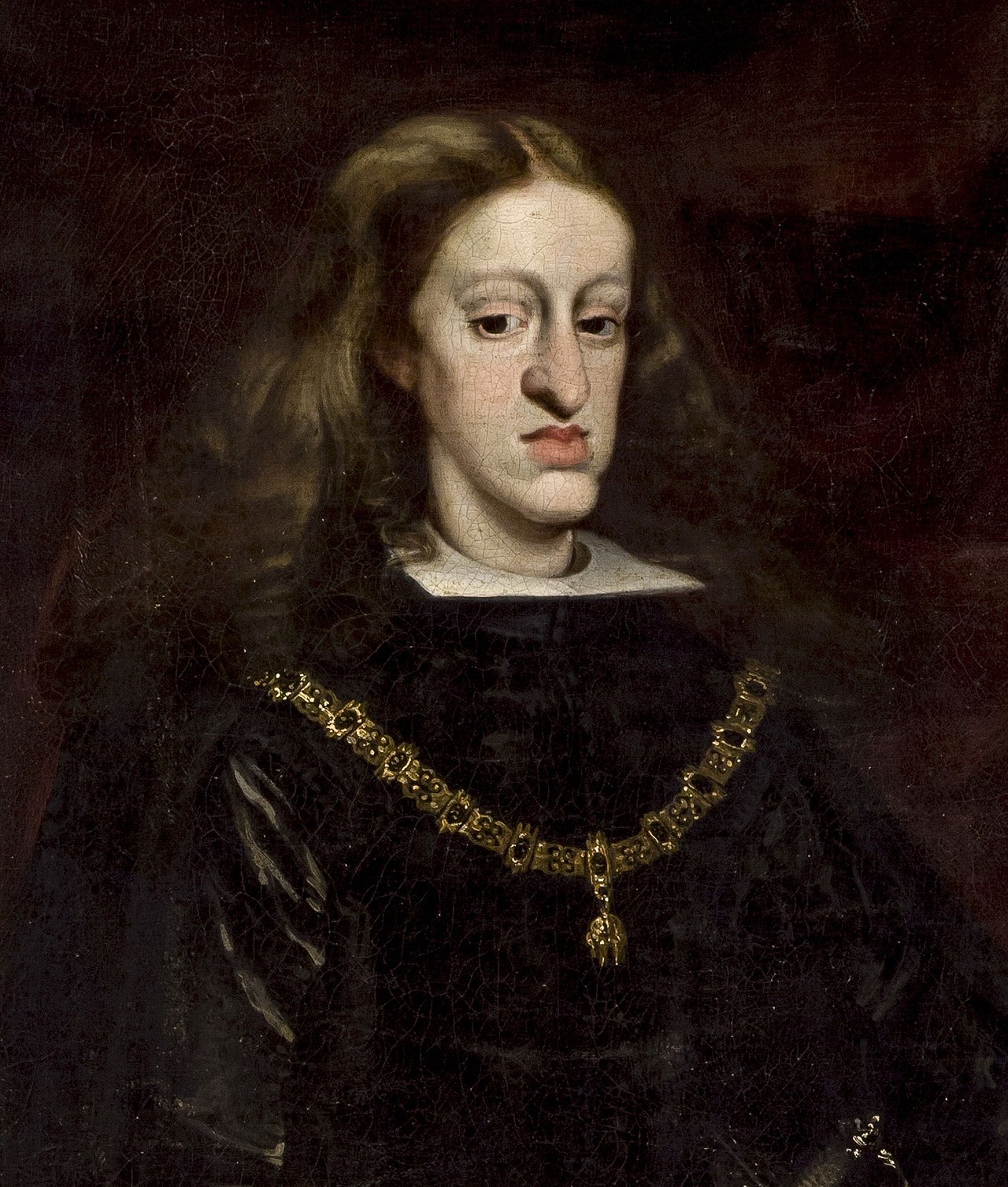
Mandibular prognathism is the clinical name for the Habsburg jaw, a condition in which the lower jaw protrudes forward relative to the upper jaw, producing a pronounced underbite and the distinctive facial profile visible across six generations of Habsburg portraiture. Clinicians classify it as Angle class III malocclusion, or skeletal class III pattern.
The popular shorthand "Habsburg jaw" collapses two distinct heritable skeletal conditions into one. Mandibular prognathism describes the forward protrusion of the mandible. Maxillary deficiency describes a recessed or underdeveloped upper jaw. Both conditions contributed to the Habsburg facial profile, and both are independently heritable. A 2019 study published in the Annals of Human Biology by González Vilas et al. treated them as separable components and found that mandibular prognathism showed the stronger statistical association with inbreeding coefficients, while maxillary deficiency contributed to the lower-face imbalance without reaching the same significance threshold. The compound of the two, not either condition alone, produced the extreme phenotype visible in Charles II of Spain.
Charles V, Holy Roman Emperor, is among the earliest rulers in whom the jaw was severe enough to affect function. Contemporary accounts noted that his malocclusion impaired his speech and contributed to social embarrassment. Maximilian I showed the trait earlier but in a milder form. The genealogical trajectory from Maximilian I to Charles II spans roughly 200 years and tracks almost perfectly with the dynasty's escalating consanguinity.
How Did Inbreeding Produce the Habsburg Jaw Across Generations?
The jaw intensified across generations because repeated consanguineous marriages drove jaw-related alleles toward homozygosity, exposing recessive skeletal traits that would have remained suppressed in a more genetically diverse lineage. By 1516, when Charles I took the Spanish throne, the House of Habsburg had already established a marriage strategy built on cousin and dynastic endogamy.
The mechanism is straightforward in principle. When close relatives reproduce, their children inherit overlapping portions of the same ancestral genome. Alleles that are recessive, requiring two copies to produce a visible trait, become increasingly likely to appear in both copies simultaneously. The Spanish Habsburg branch applied this logic systematically. A genealogical analysis covering the dynasty estimated that more than 80 percent of Spanish Habsburg marriages between 1516 and 1700 were consanguineous, including first-cousin, double-first-cousin, and uncle-niece unions.
Philip I of Castile, son of Maximilian I, carried the jaw trait into the Spanish line. His marriage to Joanna of Castile concentrated Habsburg genetics in their son Charles V. Philip II of Spain continued the pattern, marrying his niece Anna of Austria. Philip IV's marriage to Mariana of Austria, his own niece and 30 years his junior, was the critical escalation point. Charles II was the product of that union, inheriting genetic material that had been cycling through the same ancestral pool for five generations.
The 2019 Annals of Human Biology study quantified the result. Analyzing 66 Habsburg individuals across six generations using portrait-based phenotyping, González Vilas et al. found a statistically significant positive correlation between inbreeding coefficient and mandibular prognathism severity. Differences in inbreeding accounted for roughly 22 percent of the variation in jaw severity across the individuals studied. The average inbreeding coefficient across the Habsburgs analyzed was approximately 0.093, meaning about 9 percent of their paired genes were identical by descent. Charles II sat far above that average.
Autosomal recessive inheritance best fits the pattern the study documented, though the genetics of craniofacial development involve more than 20 genes and the trait does not follow a single clean Mendelian pathway. What inbreeding did was not activate one jaw gene. It simultaneously increased homozygosity across multiple skeletal developmental pathways, compounding the expression in ways that a single-gene model cannot capture.
Which Habsburg Rulers Were Most Affected by the Jaw Deformity?
The jaw deformity followed a clear generational escalation, with Maximilian I as the mild early case and Charles II of Spain as the terminal extreme. The 2019 study identified Maximilian I, Charles V, Philip IV, and Charles II as among the most severely affected across the six generations analyzed, with Charles II showing the highest inbreeding coefficient and the most pronounced compound phenotype.
Maximilian I displayed the trait visibly but functionally. Philip I of Castile showed it in portraits without documented functional impairment. Charles V was the first ruler in whom the jaw created documented social and physical consequences, including speech difficulties and the social ridicule his court records mention. Philip II showed the trait but managed it without the compound disorders that would emerge in the next generation. Philip IV presented five of the seven classically identified features of mandibular prognathism in the portrait-based scoring used by the 2019 study. Charles II also scored five of seven on the same scale, but his jaw existed alongside a cascade of additional disorders that made him the dynasty's most extreme case by almost every clinical measure.
The Austrian branch produced affected individuals but none approaching Charles II's severity. The divergence between the two branches in jaw severity maps closely onto the divergence in consanguinity rates, a point the research on the Spanish line makes explicit but does not fully explain in terms of Austrian branch genetics.
How Extreme Was Charles II of Spain Compared to Earlier Habsburg Rulers?
Charles II's inbreeding coefficient was approximately 0.254, a threshold equivalent to the offspring of a sibling union, reached not through any single sibling pairing but through the accumulation of at least 16 ancestor-relative marriages across his pedigree. That number alone separates him from every earlier Habsburg.
Philip IV, his father, had an inbreeding coefficient roughly half that magnitude. Charles V's was lower still. The jaw deformity in Philip IV and Charles V was severe enough to be documented and recognizable across their portraiture, but neither ruler suffered the compound physiological collapse that defined Charles II's reign.
Contemporary physicians described Charles II as having an enormous tongue that made speech barely intelligible, a jaw so prominent he could not bring his teeth together, and a body so frail he could not walk unaided until age eight. The historical record, and the medical literature that has retrospectively analyzed it, identifies developmental delay, dysarthria, skeletal deformity, recurrent infections, and epilepsy alongside the jaw abnormality. He was known as El Hechizado, "The Bewitched," because the severity of his impairments seemed inexplicable to contemporaries who attributed them to sorcery rather than genetics.
A retrospective medical review estimated that by Charles II's generation, the probability of a Spanish Habsburg child surviving to age 10 had fallen below 50 percent, against a contemporary Spanish village average of roughly 80 percent survival to the same age. The jaw was the most visible sign of that accumulated genetic burden. The burden itself was considerably larger.
What Did Modern Genetic Research Reveal About the Habsburg Jaw?
*The 2019 González Vilas et al. study in the Annals of Human Biology found a statistically significant positive correlation between inbreeding coefficient and mandibular prognathism severity, supporting a recessive inheritance pattern amplified by consanguinity rather than a single dominant gene explanation.*
The methodology deserves careful treatment. Researchers scored 18 facial traits from 66 Habsburg portraits across six generations, then correlated those phenotypic scores with pedigree-based inbreeding coefficients calculated from genealogical records. Fifteen Habsburg individuals had sufficient data for the full correlation analysis. The correlation coefficient between inbreeding and mandibular prognathism was 0.711, with a p-value of 0.003, statistically robust given the sample size.
The portrait-based phenotyping is the study's central methodological limitation, and popular coverage has largely ignored it. Court painters worked under political incentives. A painter commissioned by Philip IV to produce a state portrait had reasons to render the jaw in ways that served dynastic legitimacy rather than clinical accuracy. Some portraits have softened the trait; others emphasized it as a marker of bloodline continuity. The study's authors acknowledged this limitation, but naming the constraint did not eliminate it. The correlation between inbreeding coefficient and jaw severity reflects, at least partly, consistent portraiture conventions rather than consistent biology across individuals. Skeletal remains would eliminate this ambiguity, and DNA analysis of exhumed Habsburg remains has been conducted for other purposes, but the jaw-severity correlation has not yet been replicated through osteological measurement.
The study also clarified that the Habsburg jaw was not a simple dominant-gene story. Earlier family-based interpretations had proposed an autosomal dominant major gene with high penetrance. The 2019 analysis found a pattern more consistent with recessive inheritance amplified by homozygosity, meaning the trait's severity tracked with inbreeding in a way that dominant inheritance would not predict. More than 20 genes are known to influence craniofacial development, and the Habsburg phenotype likely involved multiple loci becoming simultaneously homozygous through repeated consanguinity.
Why Did the Spanish Habsburg Line Collapse While the Austrian Branch Survived?
The Spanish Habsburg line collapsed because extreme consanguinity, compounding across six generations, produced a ruler physiologically incapable of reproduction, while the Austrian branch survived by introducing sufficient genetic diversity at key generational intervals to prevent lethal recessive accumulation from reaching the same threshold.
The Spanish branch's endogamy was not merely intense, it was self-reinforcing. Each generation's marriages drew from an increasingly narrow genetic pool, and the inbreeding coefficient rose accordingly: from roughly 0.025 in Philip I to 0.156 in Philip IV to 0.254 in Charles II. The Austrian branch's pedigree, while also consanguineous by any modern standard, did not follow the same unbroken escalation. Pedigree analyses suggest the Austrian line introduced slightly greater genetic diversity at several critical generational intervals, buffering lethal recessive expression before it could accumulate to Charles II's level.
The comparison table below captures the structural difference between the two branches at the point of divergence.
| Factor | Spanish Habsburg Branch | Austrian Habsburg Branch |
|---|---|---|
| Peak inbreeding coefficient | ~0.254 (Charles II) | Well below 0.25 across the same period |
| Uncle-niece marriages | Philip IV + Mariana of Austria | Less frequent in the Austrian line |
| Child mortality rate | ~50% before age 10 | Lower, consistent with less extreme consanguinity |
| Reproductive outcome | Extinction in 1700 | Continued through the 20th century |
| Jaw severity (portrait-based) | Extreme by Philip IV; terminal in Charles II | Present but less severe |
The fiscal and military context matters too. The Spanish crown declared sovereign default multiple times across the seventeenth century. Castile suffered economic collapse in 1627, with barter conditions reported in parts of the kingdom through 1631. Spain's involvement in the Thirty Years' War and subsequent conflicts drained the treasury and the administrative capacity of the monarchy. When Charles II died childless, the Spanish state had neither the genetic resilience nor the institutional stability to absorb the succession crisis without external intervention. The Austrian branch faced its own pressures, and the male line of the main Austrian branch also expired in 1740, but it had not simultaneously accumulated the reproductive and physiological collapse that made the Spanish line's extinction total.
What Did Mandibular Prognathism and Maxillary Deficiency Actually Do to Charles II's Body?
The compound of mandibular prognathism and maxillary deficiency in Charles II produced a maxillomandibular deformity severe enough to impair mastication, articulation, and lip closure simultaneously. The lower jaw protruded beyond the upper jaw's recessed position, preventing the teeth from meeting in any functional occlusal relationship.
The practical consequences were documented by court physicians and analyzed retrospectively by medical historians. Charles II could not chew solid food effectively. His speech was dysarthric, slurred and difficult to understand, because the tongue and jaw could not coordinate normally within the malformed oral architecture. Lip incompetence, the inability to fully close the lips, is consistent with accounts describing his jaw as protruding so far that his mouth remained partially open at rest.
Modern orthognathic surgery addresses both mandibular prognathism and maxillary deficiency through Le Fort I osteotomy, repositioning the maxilla, combined with bilateral sagittal split osteotomy, repositioning the mandible. The procedure is routine in contemporary maxillofacial practice. Charles II's jaw deformity, viewed through a 21st-century clinical lens, was a correctable skeletal condition. The catastrophe was partly a product of early modern medical limits, a point that reframes the Habsburg jaw from inevitable biological destiny to contextually contingent disaster.
Can Mandibular Prognathism and Maxillary Deficiency Be Separated as Distinct Inherited Traits?
The two conditions are overlapping but not identical inherited components of Class III malocclusion, and the 2019 Habsburg study treated them as separable. Mandibular prognathism showed the stronger statistical association with inbreeding coefficient in the Habsburg data. Maxillary deficiency contributed to the lower-face imbalance but did not reach the same significance threshold independently.
Family-based genetic studies of Class III dentofacial phenotype have identified distinct linkage signals for each component. Mandibular prognathism has shown suggestive linkage at chromosomal regions including 1p36, 6q25, and 19p13.2. Maxillary deficiency studies in Hispanic cohorts have identified separate signals at 1p22.1, 3q26.2, and 12q13.13. Some loci appear to influence both structures through shared developmental regulators, meaning the traits are not fully independent, but they are not a single Mendelian unit either. For the Habsburg case, this means the dynasty was simultaneously accumulating recessive expression across at least two distinct skeletal developmental pathways, compounding the phenotype with each generation of consanguinity.
Would Orthognathic Surgery Have Saved Charles II from His Worst Symptoms?
Orthognathic surgery could have corrected Charles II's skeletal malocclusion and improved chewing and speech, but it would not have addressed the hormonal, reproductive, immunological, or neurological disorders that caused his most debilitating symptoms and his infertility. The correction would have been partial, and only for the jaw.
The medical literature on Charles II identifies a cluster of disorders extending well beyond his jaw: combined pituitary hormone deficiency, distal renal tubular acidosis, epilepsy, and developmental delay are among the conditions proposed in retrospective clinical analyses. His infertility had probable endocrine causes independent of his skeletal phenotype. Surgery corrects bone position; it does not alter the underlying recessive allele burden that produced the hormonal and reproductive failures simultaneously. The jaw was the most visible product of Habsburg inbreeding. The infertility that ended the Spanish line had deeper and more numerous genetic roots.
How Did Inbreeding Collapse the Spanish Habsburgs' Immune Systems as Well as Their Jaws?
The jaw was the most photographable consequence of Habsburg consanguinity. The deadliest was probably not.
Extreme inbreeding suppresses MHC diversity, the major histocompatibility complex that governs immune recognition of pathogens, and at Charles II's inbreeding coefficient of approximately 0.254, MHC homozygosity would have rendered him substantially more vulnerable to infectious disease than a less inbred individual. The historical record is consistent with this: Charles II suffered recurrent infections throughout his life, and contemporary physicians described a constitution so fragile that ordinary illnesses became life-threatening.
The infant and child mortality data for the Spanish Habsburg line makes the immunological and systemic consequences concrete. Among the children of Spanish Habsburg kings studied in a genealogical analysis, roughly 29 percent died before age one and 50 percent before age 10. Contemporary Spanish villages showed infant mortality of approximately 20 percent, meaning Habsburg children died at roughly one and a half times the rate of commoner children in the same country and century. The excess mortality is consistent with lethal recessive allele accumulation across multiple organ systems, not with any single disease or environmental factor.
Did Charles II's Inbreeding Coefficient Directly Suppress His Immune Function?
The evidence supports that Charles II's inbreeding coefficient of approximately 0.254 increased his overall vulnerability to inherited disorders across multiple systems, and that the pattern of recurrent infections, frailty, and early death is consistent with the consequences of extreme MHC homozygosity. The historical and genetic literature does not demonstrate direct immunosuppression as a measured biological finding, since no contemporary immunological testing existed and retrospective biomarker analysis has not been conducted on his remains for this specific question. The distinction between "consistent with" and "demonstrated by" matters for scientific precision, though it changes little about the clinical picture.
The 2019 Annals of Human Biology study's authors were explicit that the evidence for inbreeding's health consequences in the dynasty was indirect. A separate genealogical study estimated that inbreeding reduced Habsburg offspring survival by approximately 18 percent, a population-level finding that does not resolve the mechanism in any individual case but establishes the direction of effect with statistical confidence.
Was Infant Mortality Among Spanish Habsburgs Higher Than the General Population?
Spanish Habsburg infant and child mortality substantially exceeded contemporary population averages, and the excess tracked with rising inbreeding coefficients across generations. The genealogical analysis of Spanish Habsburg kings found that 50 percent of children died before age 10, against roughly 20 percent infant mortality in contemporary Spanish villages. The same study found statistically significant inbreeding depression for survival to age 10, estimating that first-cousin-level inbreeding reduced survival probability by approximately 18 percent. The inbreeding coefficient rose from roughly 0.025 in Philip I's generation to 0.254 in Charles II, and child mortality rose in parallel.
How Did Charles II's Compound Genetic Disorders Go Beyond the Jaw Alone?
Charles II's infertility, the specific failure that extinguished the Spanish Habsburg line, had multiple independent genetic causes converging simultaneously, not a single inbreeding bottleneck. His jaw was a symptom, not a diagnosis.
Retrospective medical analyses have proposed two recessive disorders as the most likely explanation for his compound phenotype: combined pituitary hormone deficiency, which would account for his short stature, impotence, and infertility; and distal renal tubular acidosis, which would account for additional systemic frailty. A separate analysis proposed aspartylglucosaminuria, a rare autosomal recessive lysosomal storage disorder, as an explanation for both the facial features and the neurological symptoms including developmental delay and dysarthria. These are competing hypotheses, not a settled diagnosis, but they share a common structure: each requires two copies of a defective recessive allele, and Charles II's inbreeding coefficient made that outcome probable across multiple loci simultaneously.
The jaw, the hormonal failure, the neurological impairment, and the reproductive collapse were not the same disorder wearing different faces. They were distinct genetic consequences of the same consanguinity strategy, accumulating independently and converging in one individual.
Did Charles II of Spain Have Klinefelter Syndrome on Top of His Jaw Deformity?
The diagnosis remains unconfirmed and contested. Medical historians have proposed Klinefelter syndrome, fragile X syndrome, and XX male syndrome as explanations for Charles II's infertility and hypogonadal features. A urology review found the phenotype, including reported posterior hypospadias and testicular atrophy, more consistent with XX male or true hermaphroditism than with Klinefelter syndrome specifically, while acknowledging that the literature remains divided. No genetic testing of Charles II's remains has confirmed any of these diagnoses. The jaw deformity belongs to the Habsburg inbreeding phenotype and does not itself indicate Klinefelter syndrome; the two conditions have distinct etiologies that happened to coexist in the same individual.
How Did the Habsburg Court Turn the Jaw Deformity Into a Symbol of Royal Power?
The dynasty's official portraiture rendered the jaw prominently across generations, effectively rebranding a medical liability as a visible marker of bloodline purity and dynastic legitimacy. Court painters did not hide it.
Titian, Velázquez, and their contemporaries worked under commissions that required projecting power and continuity. The Habsburg jaw, rather than being softened out of the frame, became part of the dynasty's visual identity, the "family face" that confirmed a sitter's legitimate place in the bloodline. One account describes the court minimizing the slackness of the lower lip while emphasizing the prominent chin, converting a skeletal abnormality into an image of aristocratic resolve. The jaw became heraldic, rendered in oil across throne rooms from Madrid to Vienna.
The political logic was coherent within its own terms. In a world where dynastic legitimacy depended on visible continuity of bloodline, a recognizable inherited trait served as biological proof of lineage. The jaw said: this person is a Habsburg, and therefore has the right to rule. That the same trait was the product of the marriage strategy that concentrated and intensified it was not a contradiction the court needed to resolve.
The 2019 Annals of Human Biology study's use of portrait-based phenotyping intersects with this political history in a way the study's popular coverage has underexamined. If court painters consistently rendered the jaw in ways shaped by dynastic image-making conventions rather than anatomical accuracy, the portrait scores used to calculate jaw severity reflect those conventions as much as underlying biology. The correlation between inbreeding and jaw severity in the study is statistically robust, but the measurement instrument, painted portraiture, was not neutral.
Did Court Painters Exaggerate the Habsburg Jaw to Please Their Royal Patrons?
Court painters appear to have normalized and selectively preserved the jaw rather than systematically exaggerating it, with the direction of image-making bias running toward dignity and dynastic continuity, not grotesque emphasis. Juan Carreño de Miranda's portraits of Charles II are described by art historians as neither hiding nor exaggerating the jaw, but rendering it with a directness that reads as realism within the conventions of late Habsburg court portraiture. Some earlier portraits of Charles V have been analyzed as showing a different facial projection pattern than true mandibular prognathism, suggesting that at least some widely circulated images were derived from shared facial templates rather than direct observation. The methodological implication for the 2019 study is real: portrait-based phenotyping introduces systematic measurement uncertainty that skeletal analysis would eliminate.
Were the Wittelsbachs and Bourbons as Inbred as the Habsburgs but Just Less Famous for It?
The Habsburg jaw's fame owes something to the dynasty's historical prominence and archival richness, not only to uniquely extreme inbreeding, though the Spanish Habsburg branch does appear to have reached inbreeding coefficients that the available evidence does not show in comparable dynasties. The Wittelsbach, Bourbon, and Braganza dynasties practiced comparable endogamy in the same era.
The Spanish Habsburg average inbreeding coefficient of approximately 0.129, rising to 0.254 in Charles II, has not been matched by published analyses of the Wittelsbach or Bourbon lines at the dynasty-wide level. The Bourbons practiced cousin marriage across the Spanish, French, and Portuguese branches, and the Wittelsbachs are frequently cited in discussions of royal consanguinity, but neither dynasty has a published pedigree analysis showing coefficients approaching Charles II's magnitude. The absence of such analysis reflects archival gaps as much as biological difference. The Habsburgs are the best-lit example of royal inbreeding pathology partly because their historical prominence generated the documentary record that made rigorous genetic analysis possible. Whether the Bourbons or Wittelsbachs harbored equivalent genetic burdens that went less documented is a question the current literature cannot fully answer.
How Did the Extinction of the Spanish Habsburg Line Reshape the Map of Europe?
The extinction of the Spanish Habsburg line triggered the War of the Spanish Succession, a continent-wide conflict from 1701 to 1714 involving France, Austria, Britain, and the Dutch Republic, whose resolution permanently redistributed European power away from the Habsburg dynastic model.
Charles II signed a will on 2 October 1700, naming Philip of Anjou, grandson of Louis XIV of France, as his successor. He died five weeks later. Before that year, the Spanish crown controlled territories across the Iberian Peninsula, the Americas, the southern Netherlands, and key Italian states. The prospect of a Bourbon heir uniting Spain's empire with France's power alarmed Austria, Britain, and the Dutch Republic sufficiently to produce a military coalition. The war lasted 13 years. The Treaty of Utrecht in 1713 confirmed Philip V as King of Spain while stripping the Spanish crown of its Italian and Low Countries territories, distributing them to Austria and other parties. Spain remained under the Bourbons. The Habsburgs retained their Austrian base but lost their Spanish empire permanently.
The geopolitical consequences of Charles II's infertility dwarfed the medical ones. Two centuries of consanguineous marriage, undertaken to keep power and territory within the Habsburg bloodline, ended by triggering the largest redistribution of European power since the Reformation. The jaw was the visible symptom. The war was the political invoice.
What Does the Habsburg Jaw Tell Us About the Price of Dynastic Inbreeding?
The Habsburg jaw was not one bad gene. It was the most visible product of a consanguinity strategy that simultaneously drove two distinct skeletal developmental pathways toward homozygosity, suppressed immune diversity, accumulated lethal recessive alleles across hormonal and reproductive systems, and produced infant mortality rates roughly 2.5 times the contemporary population average, all while the dynasty's court painters rendered the resulting phenotype as a symbol of legitimate power.
Charles II of Spain was the convergence point of those independent genetic consequences. His jaw, his hormonal failure, his neurological impairment, and his infertility were not one disorder. They were distinct recessive outcomes of the same marriage strategy, accumulating across six generations and arriving simultaneously in one individual whose inbreeding coefficient exceeded the offspring of a sibling union. The Spanish line's extinction in 1700 was genetically overdetermined long before Charles II was born.
The Austrian Habsburg branch's survival into the twentieth century extends rather than contradicts this analysis. Nearly identical marriage conventions, applied with slightly greater genetic diversity at critical generational intervals, produced a branch that showed the jaw trait without accumulating the compound reproductive and physiological collapse that ended the Spanish line. The difference between survival and extinction, in the Habsburg case, was measured in fractions of an inbreeding coefficient.
Charles II's autopsy, recorded by court physicians, described a body so deteriorated that the examining doctors reportedly said it did not contain a single drop of blood that was not corrupted. That description is almost certainly hyperbole. The genealogical record behind it is not.