Maximilian I died at Wels on 12 January 1519, having never paid most of his debts, never crushed the Swiss Confederation, never launched the crusade he spent decades promising, and never received a papal coronation as Holy Roman Emperor. His contemporaries in Italy called him Massimiliano di pochi denari, Maximilian the Moneyless. The gap between that documented reality and the triumphalist image of the "Last Knight" is not a minor historiographical footnote. It is the central fact of his reign, and it explains almost everything about how the House of Habsburg actually expanded during his lifetime.
What Was Maximilian I's Role in the Holy Roman Empire and How Did He Define Habsburg Imperial Authority?
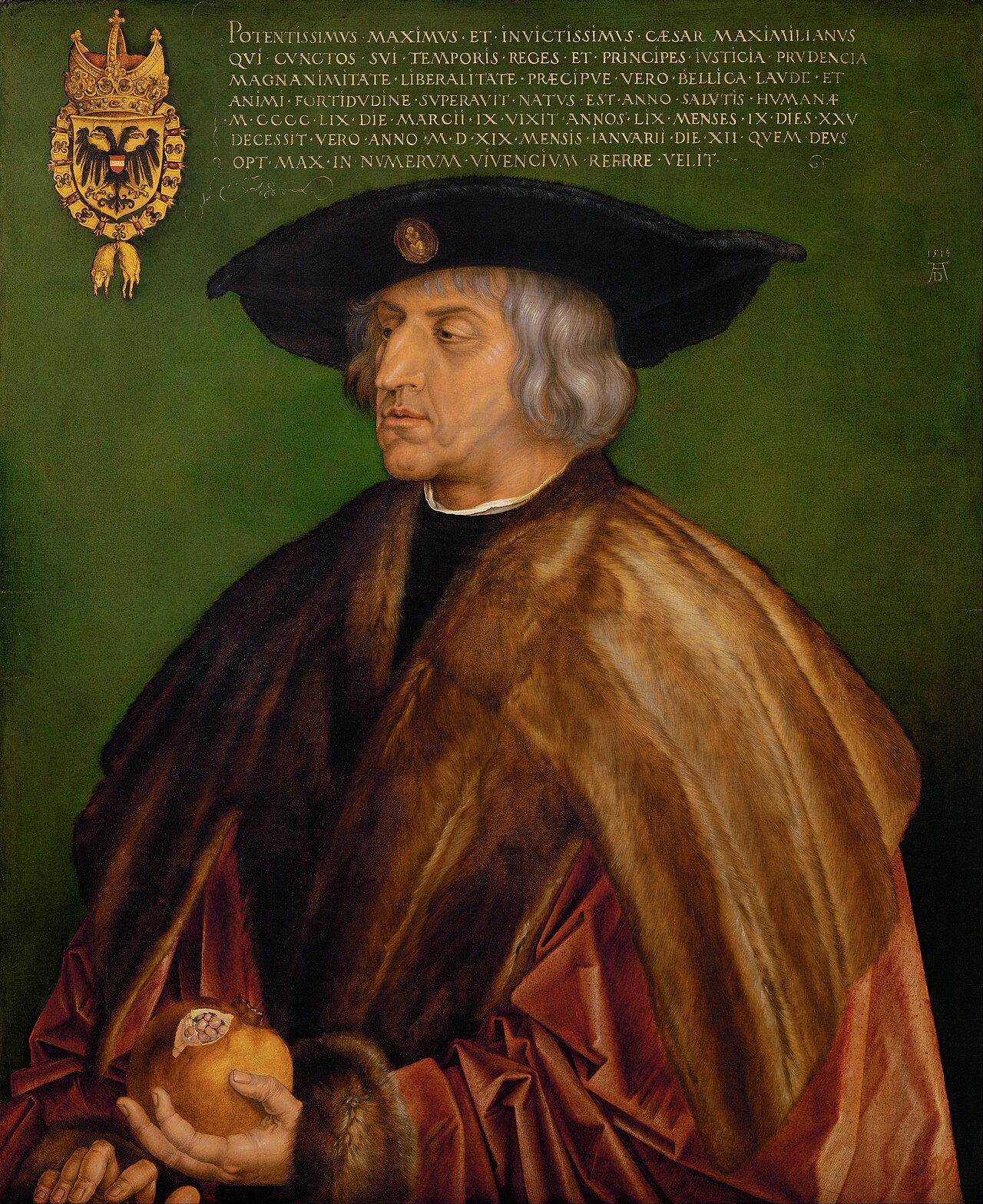
Maximilian defined Habsburg imperial authority not through centralized administration but through the accumulation of dynastic claims, selective institutional reform, and the constant management of debt and alliance. He became Archduke of Austria in 1486, was elected King of the Romans the same year, and proclaimed himself Holy Roman Emperor in 1508 without a papal coronation, a break with custom that Pope Julius II eventually recognized. Where institutional precedent blocked him, he improvised.
The Holy Roman Empire's structure constrained everything he attempted. Imperial authority was fragmented across hundreds of princes, cities, and ecclesiastical territories, each with their own fiscal and military obligations and very little inclination to fund an emperor's Italian ambitions. Maximilian's response was to pursue reform in ways that preserved his own prerogatives while offering the estates enough to secure their cooperation. At the Diet of Worms in 1495 he agreed to the Reichskammergericht, an imperial supreme court, and accepted the concept of a Common Penny tax. At Augsburg in 1500 he consented to a Reichsregiment, a central imperial government, though he kept trying to appoint its members himself and had it abolished within two years once it threatened to become genuinely independent. The pattern repeated across his reign: propose reform, accept compromise, dismantle what grew inconvenient.
Where the imperial apparatus failed him, he fell back on the hereditary Habsburg lands. His administrative consolidation in those territories was more durable: he merged the Court and Imperial Chanceries in 1502, established a general treasury at Innsbruck, and in 1518 issued the Innsbrucker Libell organizing provincial defense and conscription. Innsbruck, not Vienna or Frankfurt, was the real administrative center of his power. The broader lesson his reign taught the dynasty was that Habsburg imperial authority would rest on dynastic resources first and imperial institutions second, a lesson Charles V absorbed and institutionalized.
For readers tracing the full sequence of Habsburg emperors and their reigns, Maximilian sits at the hinge between the medieval and early modern dynasty: the last emperor to operate primarily through personal chivalric authority, and the first to deploy print, bureaucracy, and banking credit as systematic instruments of rule.
How Did the Burgundian Inheritance Compare to What Maximilian Actually Gained from Marrying Mary of Burgundy?
The 1477 marriage to Mary of Burgundy is the event around which Maximilian's reputation as a dynastic genius is most often built, but the actual transaction was messier and more dangerous than that reputation implies.
Mary's inheritance, on paper, was extraordinary: the Burgundian Netherlands, the Duchy of Burgundy, the Free County of Burgundy, and scattered territories across both France and the Empire. Louis XI of France moved immediately to seize the French-held core, including the Duchy of Burgundy itself, in the same year the marriage was contracted. Maximilian never recovered those territories. The Treaty of Senlis in 1493 left him with most of the Burgundian domains within the Empire, but the richest French-held prize remained permanently outside Habsburg reach.
| Category | What Mary's Claim Included | What Maximilian Actually Secured |
|---|---|---|
| Territorial scope | Netherlands, Burgundy proper, Free County, French and Imperial lands | Most Burgundian lands within the Empire after 1493 |
| French crown fiefs | Duchy of Burgundy and other territories | Lost to Louis XI in 1477; never recovered |
| Immediate control | Mary ruled the Netherlands; Maximilian was co-ruler | Co-rulership only; sole control passed through Philip after Mary's death |
| Dynastic result | Intended to remain within Burgundian line | Anchored Habsburg western expansion through Philip I and Charles V |
Mary died in 1482 following a riding accident, leaving Maximilian to defend the inheritance for their son Philip against both French pressure and the defiant Flemish urban elites who had extracted the Grand Privilege from Mary in 1477. The Bruges episode of 1488 illustrated the liability most starkly: the burghers of Bruges imprisoned Maximilian himself for several months, forcing humiliating concessions before releasing him. Popular accounts of the Burgundian marriage as an unqualified dynastic windfall consistently omit this detail.
The deeper significance was structural rather than territorial. The Burgundian acquisition delivered the Order of the Golden Fleece, a court culture of extraordinary ceremonial sophistication, and a network of commercial connections across the Low Countries that would later finance Spanish imperial ambition. It also delivered a permanent war with France over Burgundian succession rights, a conflict that drained Habsburg resources across three generations. The key Habsburg marriage alliances in Burgundy and Spain produced both the dynasty's greatest asset and its most persistent strategic liability simultaneously.
How Did Maximilian's Military Reforms Compare to His Actual Record on the Battlefield?
The Landsknecht formations Maximilian patronized in the late fifteenth century became the dominant infantry of early sixteenth-century European warfare, but his personal battlefield record was one of chronic failure. The pike-and-arquebus tactics they standardized, the military codes he imposed, the artillery workshops at Innsbruck, these were genuine institutional contributions that outlasted his reign by decades. His 1508 military code of twenty-three articles, regulating camp conduct and requiring obedience to imperial authority, directly informed military law under Charles V. The Innsbrucker Libell of 1518 organized provincial conscription and mutual defense across the Habsburg lands with a coherence his predecessors never attempted.
| Dimension | Reform Achievement | Battlefield Record |
|---|---|---|
| Infantry | Created Landsknecht corps modeled on Swiss pike tactics | Failed repeatedly against the Swiss Confederation |
| Artillery | Backed Innsbruck workshops; standardized gunpowder weapons | Italian campaigns largely unsuccessful despite artillery |
| Military law | 1508 code of 23 articles; influenced law under Charles V | Campaigns cut short by funding collapse |
| Frontier defense | 1518 Innsbrucker Libell organizing provincial defense | Ottoman crusade never progressed beyond rhetoric |
Against the Swiss, he failed. In Italy, he failed. Contemporaries noticed. Roughly seventy percent of his income went to wars, a share that left no margin for the sustained campaigns northern Italy required. The nickname Massimiliano di pochi denari was not affectionate.
The Holy Roman Empire could not reliably fund sustained military operations because its princes controlled their own revenues and had every incentive to resist imperial taxation. Maximilian was building systems, not winning wars, and the systems survived him. The Landsknecht formations proved decisive at Pavia in 1525, six years after his death, when Charles V's forces destroyed the French army in the engagement that defined the Italian Wars. Maximilian built the instrument. Charles used it.
How Did Maximilian's Marriage Diplomacy for His Grandchildren Compare to His Own Burgundian Match as a Dynastic Strategy?
The Burgundian marriage was acquisitive in the immediate sense: it delivered territory, ceremonial culture, and a commercial network within Maximilian's own generation. The marriages he arranged for his grandchildren operated on a different timescale and through a different mechanism.
| Strategy | Marriage | Immediate Result | Long-term Result |
|---|---|---|---|
| Maximilian's own match | Mary of Burgundy, 1477 | Co-rulership of Burgundian lands | Foundation of Habsburg western expansion; permanent conflict with France |
| Son Philip's match | Joanna of Castile, 1496 | Dynastic claim on Spanish crowns | Charles V inherits Castile, Aragon, and overseas empire |
| Grandchildren's double marriage | Ferdinand/Anna and Mary/Louis (Jagiellonian, 1515) | Hereditary claims on Bohemia and Hungary | Habsburg acquisition of both kingdoms after Mohács, 1526 |
The 1515 double wedding at Vienna, where Ferdinand was paired with Anna of Bohemia and Hungary and Mary with the future Louis II, was a future-oriented investment rather than a present-tense acquisition. It paid off only when Louis II died at Mohács in 1526 without a male heir, transferring Bohemia and Hungary to Ferdinand I. Maximilian had been dead for seven years by then.
The failure rate of the broader strategy is worth noting. The proxy marriage to Anne of Brittany in 1490 was annulled two years later when Charles VIII of France seized her for himself, a diplomatic humiliation with no territorial compensation. The 1493 marriage to Bianca Maria Sforza of Milan produced no children and no lasting political dividend. Maximilian spent money on the Sforza match that he could not afford, received a dowry that went immediately toward war debts, and gained nothing durable in northern Italy.
What the eventual success under Charles V obscures is how many of the intermediate steps were contingent. Philip the Handsome died in 1506, leaving Joanna mentally incapacitated by grief and the Spanish succession in crisis. Had Philip lived, the Habsburg-Spanish relationship might have developed very differently. Charles V's extraordinary inheritance was the outcome of a probabilistic process that included several near-misses, not the execution of a design that Maximilian had mapped in advance.
What Were the Main Forms of Maximilian's Patronage of Arts and Humanist Culture?
Maximilian's cultural patronage was a coordinated propaganda operation, not a passive enthusiasm for Renaissance learning. The outputs were substantial and technically sophisticated, but the driving logic was political.
The most ambitious project was the Triumphal Arch, a woodcut composition designed with Albrecht Dürer running to 192 separate printed sheets, depicting Habsburg genealogy, military victories, and dynastic allegory on a monumental scale. Nothing comparable had been attempted in print. The Theuerdank, an autobiographical chivalric romance published in 1517, cast Maximilian as a knight overcoming allegorical dangers on the way to his marriage, with a typeface specially commissioned to resemble manuscript handwriting, a design choice that disguised the printed pamphlet as something more ancient and authoritative than it was.
Court humanists served a specific function within this apparatus. Conrad Celtis, crowned Poet Laureate by Maximilian in 1487, was tasked with producing genealogical works tracing Habsburg descent from ancient Rome and, further back, from Troy. The scholarly output was instrumentally commissioned, not independently generated. Willibald Pirckheimer, Ulrich von Hutten, and others operated within the same framework: their learning was real, but their work for the court was shaped by what the dynasty needed legitimized.
The University of Vienna, where Maximilian established a College of Poets and Mathematicians, and the Sodalitas litteraria Danubiana that Celtis organized, gave the propaganda apparatus an institutional infrastructure. Heinrich Isaac and Paul Hofhaimer provided the musical dimension. The cenotaph project at Innsbruck, the bronze figures of Habsburg ancestors surrounding an empty tomb, since Maximilian was actually buried at Wiener Neustadt, extended the image-making into three dimensions and into permanence.
The print dimension was the most consequential. Maximilian deployed the woodcut series, the printed pamphlets, and the Triumphal Arch as what the research record describes as arguably the first systematic use of mass-print media by a European monarch to manufacture imperial legitimacy. The technology was thirty years old when he began exploiting it; no previous ruler had used it at this scale or with this degree of coordination between text, image, and dynastic narrative.
How Does Maximilian's Celebrated Legacy Compare to What the Archival Record Actually Shows?
The "Last Knight" label does real historiographical damage because it collapses the distance between Maximilian's self-presentation and his documented record. The archival picture is more complicated and, in some respects, more interesting.
| Dimension | Celebrated Legacy | Archival Record |
|---|---|---|
| Territorial expansion | Transformed Habsburg from minor to major European power | Lost Switzerland; lost French Burgundy; Bruges imprisonment; Bianca Maria marriage produced nothing |
| Military innovation | Created Landsknecht; reformed artillery and military law | Chronic battlefield failure; Italian campaigns disastrous; crusade never launched |
| Imperial reform | Built foundations of modern imperial administration | Reichsregiment abolished after two years; princes consistently resisted centralization |
| Financial management | Funded ambitious dynastic projects | ~70% of income spent on wars; debt at death ~6-6.5 million gulden; relied on Fugger credit |
| Cultural patronage | Renaissance prince; genuine humanist | Coordinated propaganda operation; genealogies fabricated; "Last Knight" was self-constructed |
The celebrated legacy is not entirely wrong. Maximilian did expand Habsburg power. He did create durable military institutions. He did establish a propaganda apparatus of genuine sophistication. The problem is that the triumphalist account treats these achievements as the product of coherent strategy when the archival record shows they were frequently accidental, heavily subsidized by Fugger credit, and built on a foundation of institutional compromise rather than imperial command.
The self-constructed nature of the image is perhaps the most important corrective. Much subsequent historiography has narrated his reign through a lens he himself designed, printed, and distributed. The Theuerdank romance, the Triumphal Arch, the fabricated genealogies, these were not cultural by-products of his reign. They were its most carefully managed outputs, and they shaped how historians from the sixteenth century onward understood the man who commissioned them.
What Was the Fugger Partnership and Why Did It Make or Break Maximilian's Dynastic Projects?
The Fugger partnership was the financial engine without which Maximilian's dynastic projects would not have been possible. The relationship between the Augsburg banking house, particularly under Jakob Fugger, and the Habsburg court was not a conventional lender-borrower arrangement. It was a mutual dependency linking Habsburg statecraft to Fugger mining rights, copper monopolies, and international credit networks.
The mechanism worked through Tyrol. The silver and copper mines of the Tyrolean Alps generated revenues that the Habsburgs held but could not efficiently monetize. They had the assets; they lacked the cash. The Fuggers converted mineral wealth into usable capital through a system of loans secured against future mining revenues, gaining in return expanding rights over copper extraction and trade. Copper mattered because it was essential for casting guns, which meant the Fuggers could, in principle, constrain Habsburg military capacity by controlling access to a critical war material.
The scale of the financial support was not marginal. Fugger backing for Maximilian's imperial accession reportedly ran to 800,000 florins. These were not loans to a solvent ruler managing a temporary cash-flow problem. They were structural financing for a dynasty that spent roughly seventy percent of its income on warfare and ended Maximilian's reign six to six-and-a-half million gulden in debt.
The partnership also shaped the dynasty's strategic options in ways that rarely appear in popular accounts. Habsburg military operations, Italian campaigns, and marriage negotiations were all constrained by what the Fugger credit lines could support and what the Tyrolean mining revenues could service. The Austrian State Archives and the Tyrolean documentary collections make this fiscal dependency explicit. Any account of Maximilian's reign that treats the Fuggers as a footnote rather than as co-authors of Habsburg expansion has misread the primary record.
Did the Fugger Loans Give the Habsburgs a Structural Advantage Over Their Rivals?
The Fugger relationship gave the Habsburgs a genuine advantage in imperial elections, military finance, and resource procurement that rival dynasties could not easily replicate. The advantage was real but fragile: it translated political ambition into operational capacity faster than competitors could manage, while simultaneously deepening a debt dependency that constrained Habsburg policy for decades.
The evidence is concrete. Fugger money financed Maximilian's accession and the military operations that secured Habsburg control across the composite monarchy. At Pavia in 1525, the imperial army could not have been raised or supplied without Fugger loans. No rival house had access to a comparable combination of banking credit, mining revenues, and commodity control. The Fuggers' near-monopoly on European copper supply was not incidental to their value as a partner: it meant they could both fund Habsburg armies and influence the material conditions of Habsburg warfare.
The fragility is equally documented. The advantage held only as long as Tyrolean mining revenues remained sufficient to service the debt and as long as the Fuggers judged the Habsburg credit risk acceptable. It tied Habsburg policy to the interests of a single banking house in ways that reduced strategic flexibility. The debt Maximilian left at his death was not a temporary imbalance; it was a structural condition that his successors inherited along with the empire.
Could Maximilian's Italian Campaigns Have Succeeded With Better Funding?
Better funding would probably have made the Italian campaigns more competitive. It would not have resolved the deeper strategic problem.
The financial constraint was severe and documented. Campaigns were cut short when money ran out. The nickname Massimiliano di pochi denari reflected a pattern contemporaries recognized in real time. His 1508 attack on Venice ended in an unfavorable truce and territorial losses despite the theoretical strength of the League of Cambrai. The Common Penny tax, designed to fund military operations through imperial estates, failed to generate the revenues projected because the princes resisted collection.
Beneath the fiscal problem lay a strategic one: even well-funded operations in Italy faced opponents, terrain, and political configurations that made durable conquest extremely difficult. The French, Venetians, and papacy each had their own resources and their own reasons to prevent Habsburg consolidation in northern Italy. More money would have produced longer campaigns. It would not necessarily have produced the stable territorial control Maximilian sought.
How Did the Landsknecht Transform European Warfare While Undermining the Knightly Class Maximilian Championed?
The contradiction at the center of Maximilian's military legacy is this: the man who styled himself the Last Knight was simultaneously the ruler most responsible for making the armored knight militarily redundant.
The Landsknecht formations Maximilian patronized after 1486 were modeled on Swiss mercenary infantry that had already demonstrated, in the Burgundian Wars, that massed pikes and halberds could blunt cavalry charges and kill knights at scale. The 1488 Swabian League army of 12,000 infantry and 1,200 cavalry, described in the sources as the first organized Landsknecht force raised in Germany, institutionalized that lesson. Pike squares backed by arquebusiers could hold ground against heavy cavalry and, in the right conditions, destroy it. The feudal knight's monopoly on shock combat, which had structured European military organization for centuries, did not survive the pike-and-shot revolution that Maximilian helped accelerate.
The social implications were equally corrosive for the class Maximilian romanticized. Mercenary infantry drawn from artisans and peasants displaced the noble cavalry that had defined military status. Some members of the lower nobility joined the Landsknecht formations themselves, which meant they were absorbed into a system that had already undermined their social distinctiveness as warriors. By the mid-sixteenth century, expanded gunpowder use had reduced even the pike expertise that originally defined the Landsknecht, and the formations themselves were dissolving into the broader professional armies of the early modern state.
Did the Landsknecht Make the Feudal Nobility Militarily Obsolete Within Maximilian's Own Lifetime?
Cavalry remained militarily relevant through 1519 and beyond. The Burgundian Wars had shown that heavy cavalry was vulnerable to disciplined pike formations, but vulnerable is not the same as obsolete. Mixed armies continued to deploy mounted nobles alongside Landsknecht infantry throughout Maximilian's reign, and the decisive transformation was still unfolding in the decades after his death, particularly under Charles V.
What changed within Maximilian's lifetime was the balance of battlefield prestige and tactical centrality. The knight was no longer the decisive arm. The infantry square was. That shift was clear enough by 1500 that it shaped military recruitment, military law, and military finance across the Empire. The feudal cavalry did not disappear; it lost its monopoly. Full obsolescence came later, as gunpowder weapons made even the pike's dominance temporary.
Was the 'Last Knight' Epithet Maximilian's Own Invention or a Later Historians' Label?
The epithet was neither purely self-invented nor purely a later construction. Maximilian actively promoted the persona through the Theuerdank romance and other autobiographical works, styling himself in the chivalric mode throughout his reign. The fixed phrase "the Last Knight" as a historical label gained wider currency later, particularly through Anastasius Grün's nineteenth-century poem Der letzte Ritter, which codified what had been a contemporary association into a durable historiographical epithet.
Maximilian participated in creating the persona that made the label stick, and subsequent historians reproduced it without always recognizing that their source was the man himself. The Theuerdank typeface designed to resemble manuscript handwriting, the woodcut series depicting knightly virtue, the fabricated genealogies connecting Habsburg descent to ancient heroes, these were not neutral records of a chivalric temperament. They were a coordinated image-management campaign, and the "Last Knight" label is its most lasting product.
Where Did Maximilian's Marriage Diplomacy Fail and Which Alliances Produced No Male Heirs?
The failures cluster in Brittany and Milan, with implications that extended well beyond the immediate diplomatic humiliation.
The Brittany negotiation of 1490 ended in outright defeat. Maximilian had arranged a proxy marriage to Anne, heiress to the Duchy of Brittany, which would have given the Habsburgs a strategic position on France's Atlantic coast. Charles VIII of France moved faster, secured Anne for himself, and had the proxy marriage annulled in 1492. Maximilian received no territorial compensation and no alternative alliance from the episode.
The Milan marriage was more expensive and equally barren. Bianca Maria Sforza brought a substantial dowry in 1493, which went directly toward Maximilian's war debts. The marriage was unhappy, Bianca was politically isolated at the imperial court, and the union produced no children. The dynastic rationale for the Sforza match, securing Habsburg influence in northern Italy through family connection, never materialized.
By contrast, the Burgundy marriage of 1477 and Philip's marriage to Joanna of Castile in 1496 delivered what the failed alliances did not: surviving children who carried Habsburg claims forward. The success rate of the overall strategy was lower than retrospective accounts imply, and the eventual consolidation under Charles V depended on the survival of specific individuals through specific contingencies.
Was the Consolidation Under Charles V the Result of a Masterplan or a Series of Accidents?
Charles V's inheritance was the product of dynastic accumulation, strategic family planning, and contingent historical events, not a single coherent masterplan. The Habsburg habit of using marriage and inheritance to accumulate power was deliberate and consistent. The specific configuration that Charles inherited was not.
Philip the Handsome's death in 1506 left the Spanish succession uncertain for years. Louis II's death at Mohács in 1526 transferred Bohemia and Hungary to Ferdinand only because the Jagiellonian line had no viable male heir. Had either contingency resolved differently, Charles's empire would have been substantially smaller. The 1549 Pragmatic Sanction, which defined the Habsburg Netherlands as a unified hereditary entity, was a retrospective consolidation of holdings that had accumulated through separate processes, not the execution of a plan Maximilian had drawn in advance.
The 1556 division of the Habsburg dominions into Spanish and Austrian branches was itself driven by practical constraints: religious division in Germany, Ottoman pressure, financial exhaustion, and Charles's declining health. The split was workable, not designed. The dynasty's two-branch structure for the following century and a half was the outcome of pressures Maximilian could not have anticipated.
How Did Maximilian's Imperial Reform Agenda Compare to What the German Princes Actually Accepted?
Maximilian wanted reform that preserved imperial supremacy. The princes wanted reform that distributed power to themselves. Neither got exactly what they wanted, and the result was a constitutional compromise that constrained Habsburg authority for the next three centuries.
At Worms in 1495, the princes backed the Common Penny tax and the Reichskammergericht in exchange for an Imperial Government that would reduce the emperor to an honorary role. Maximilian refused the restriction at first, then accepted a modified version at Augsburg in 1500 once the estates had committed their own troops to his campaigns. He had the Reichsregiment abolished within two years. The Monumenta Germaniae Historica and the Regesta Imperii record the sustained opposition to centralization at both diets in detail that the label "state-builder" consistently obscures.
The long-term outcome was a mixed constitutional order in which emperor and estates shared power through the Reichstag. That framework was durable precisely because it was a compromise rather than an imperial victory. Maximilian's institutional legacy was therefore real but contested: he helped create common structures that outlasted his reign, while failing to achieve the stronger central authority he sought. The German princes never genuinely accepted his centralizing vision; they accepted a diluted version that served their own interests.
What Did Maximilian's Ottoman Frontier Policies Establish for Later Habsburg Rulers?
Maximilian's approach to the Ottoman threat established the basic pattern of defensive, border-based management that his successors inherited as a structural condition rather than a temporary problem.
His reign saw the Habsburgs treating the southeastern frontier as a permanent military zone requiring continuous organization. Britannica records that he drove Ottoman forces from his southeastern borders through a combination of military pressure, treaties, and marriage alliances, the same toolkit he applied everywhere else. The Jagiellonian double marriage of 1515 was partly motivated by the need to stabilize the Hungarian frontier against Ottoman pressure, linking dynastic diplomacy directly to frontier defense.
From 1527 to 1606, the Habsburg and Ottoman empires fought nearly constant war along the Hungarian and Croatian frontier, with intermittent peace treaties beginning in 1547. That pattern was already visible during Maximilian's reign: the Ottoman threat was not an emergency to be resolved but a permanent strategic condition to be managed through fortified borders, military organization, and negotiated truces. His crusade rhetoric, which never produced an actual crusade, established the ideological grammar of Habsburg-Ottoman confrontation, the dynasty as defender of Christendom against the infidel, that his successors would deploy for the next century. The rhetoric outlasted the man by far longer than most of his actual achievements.
How Did Maximilian I Shape the House of Habsburg's Identity for the Centuries That Followed?
The most consequential thing Maximilian left behind was not territory, not institutions, and not military technology, but a dynastic architecture built on the gap between ambition and execution , and the discovery that this gap could itself be productive.
His reign demonstrated that the House of Habsburg could expand through marriage and inheritance faster than through conquest, that banking credit could substitute for reliable imperial taxation, that print could manufacture legitimacy more efficiently than battlefield victory, and that a ruler who lost most of his wars could still die having transformed his dynasty's position in Europe. None of these lessons were planned. They emerged from the specific pattern of his failures and the specific resources he used to compensate for them.
The propaganda apparatus he built shaped Habsburg self-presentation for generations. The chivalric ceremonial of the Order of the Golden Fleece, the monumental visual programs, the genealogical claims to Roman and Trojan descent, these became the dynasty's public identity, reproduced and elaborated by his successors long after the specific political conditions that produced them had dissolved. Charles V inherited not just territories but a way of representing Habsburg authority that Maximilian had designed and tested.
The Fugger dependency was inherited too, along with the debt. The financial structure that made Maximilian's projects possible also constrained his successors, tying Habsburg policy to the interests of the Augsburg banking house through the reign of Charles V and beyond. The Tyrolean silver mines eventually declined; the debt did not.
What Maximilian did not leave behind was a centralized imperial state. The German princes had blocked that at Worms and Augsburg, and the constitutional compromise that resulted meant the Holy Roman Empire would remain a confederation of semi-autonomous territories governed through negotiation rather than command. The Habsburg emperors who followed him operated within that constraint, using dynastic resources and Fugger credit to pursue objectives the imperial apparatus could not fund.
By January 1519, the architecture was in place: the Burgundian Netherlands, the Spanish connection through Philip and Joanna, the Bohemian and Hungarian claims through the Jagiellonian marriages, the Landsknecht formations, the military codes, the propaganda apparatus, the Fugger credit lines, and the Ottoman frontier ideology. Charles V would spend his reign trying to govern what Maximilian had assembled. The assembly itself took thirty-three years, cost six and a half million gulden in accumulated debt, and produced a dynasty that dominated European politics until 1918. Maximilian died at Wels, in debt, having requested that his body be scourged and his teeth knocked out as acts of penitence. The cenotaph at Innsbruck, with its bronze ancestors surrounding an empty tomb, remains the more lasting self-portrait.